What You Need For Your Photoshoot
One of the first questions I ask a new potential client is “Do you have a list of shots you need?” I’m happy to work with them either way but it helps me gauge how much they may have thought about the details and logistics of their shoot. Generally, when clients come to me with a list of shots, it means they’ve done some prep work, have a good idea of their brand identity (or brand identity they aspire to), and may already be working with a designer or marketing person either internally or externally.
A photography shot list outlines all the images you want to capture, along with detailed notes describing their framing, color, composition, and more. If you’re investing in a professional photographer to enhance your visual marketing, a detailed shot list helps you make the most of your time.
Below, I’m going to break down everything you need to know about a photography shot list.
Continue reading to learn:
- What a shot list is
- Why a shot list is important for photographers, business owners, marketing & advertising teams, and other creative professions
- What to consider before creating one, and
- How to create a shot list for your photographer or client
What is a Shot List?
It is exactly as it sounds, a detailed outline of every image that a photographer should capture during the duration of a commercial photoshoot. It’s a plan crafted between you and your photographer to set up a successful engagement. A list of photographs that you or your company needs to walk away from a shoot with. Usually they come to me in spreadsheet or PDF form and they work best when they have a brief description of each shot. Here’s an example: Shot #1: Horizontal (landscape) shot, waist up, of female model holding green smoothie product with beach/coastal element in background.
This is a great (and more than sufficient) description because, although it is brief, it allows for creative freedom and still covers all the important bases: layout, crop, background, props/environment. It may seem confining, but the photographer can still play with angle, lighting, depth of field, posing, styling and much, much more while remaining comfortably in the confines of that description.
Whether you’re a small business owner in charge of everything or an art director at a major corporation, it’s crucial to work with the photographer when building a collaborative shot list. If you’ve done your due diligence and found the right photographer for your project, you might have outlined a general list of shots you’d like to capture in your initial communication. A shot list takes planning to the next level.
Why do I need to provide a Shot List?
There are several benefits to developing a shot list prior to requesting a quote or at least prior to the photo shoot. While high-quality, professional images are key to visually marketing your brand, some business owners view photography as an additional expense. In reality, it is an investment, and you want to get the most out of your money and time.
A thorough shot list ensures that your photo shoot will maximize the time you have and leave you with more than enough images in your asset library.
A few additional reasons why a shot list is important include:
- Make sure that you’re on the same page as your photographer: Again, this is probably covered in the initial communication you have with a photographer. If there’s any concern that the photographer doesn’t understand what you’re looking for, a shot list details each and every image that you can expect to receive from your session.
- Define what you need to engage with customers every step of the way: As you and the photographer draft a shot list, you can think about and clearly define what types of images are more likely to resonate with consumers and lead them to connect emotionally with your business.
- Keep branding consistent across your image library: Creating a visual brand relies on a consistent look for every image – incorporating brand colors and providing an authentic representation of your business. When creating a shot list, you can get specific about framing, lighting, color design, and other components to ensure that all of your final images are on brand.
What To Consider Before Creating A Shot List
Before you connect with your photographer to create your shot list, spend some time compiling a list of considerations to address. Some questions to ask yourself include:
- What are you going to use the photos for?: Are you looking for a cohesive set of images to launch a specific marketing campaign with? Do you need portraits and commercial lifestyle images of your staff and office to create a new website or update your existing site? The specific use of images informs the type of shots you’ll need.
- What types of images do you need to be on brand?: If you’re an outdoor brand, you might want all of your images to live outside. That means employee headshots, product photos, and lifestyle photos should be set in the outdoors. Whatever you feel is more important for your photos to match your brand identity, make sure to decide and bring it up with your photographer.
- Do you want any specialty shots or unique compositions?: If you want a header image with room for labels, you’ll want to call that out. If you don’t, you could find that none of the images for your session work as a header. Calling out any shots that require additional framing or thought helps to avoid making costly mistakes on the day of the shoot.
- Do you need any props, location scouting, or travel accommodations?: If you have a manufacturing facility overseas and want to highlight your workers in a marketing campaign, you’ll need to address the necessary travel accommodations to make it possible. Any props you need to acquire, locations you need to view, or travel accommodations you need to make should be considered before you get to the phase of creating a shot list.
Getting an Accurate Quote
I can’t speak for all photographers, but my quotes are based on a multitude of factors including how many final deliverables will be needed from the shoot (most of the work I do is commercial, so usage is important). I also base the quote on anything needed in terms of production costs (talent, makeup, set design, props, wardrobe, travel, studio time, crew) and how difficult the shots are to execute, and of course retouching time. For example if the shot is: “Whole loaf of bread, eye level, white background” that will take a lot less time to shoot and edit than “High end dive watch, moody lighting, splashes of blue water coming in hitting watch from left and right, gradient yellow background.”
Getting the Most out of your Budget
The biggest reason is obviously to get the most possible bang for your buck. The more you can plan ahead and describe what you need, the more likely you are to get the desired outcome in terms of long lasting usable material.
A shot list also helps me identify shots that are not as necessary as a client once imagined. IE: “donut top view” followed by “donut 3/4 top view” and “donut front view”. Perhaps we can pare that list down and show your audience the needed information for a lot less money! Quality over quantity is always the best choice.
We Make it Look Easy
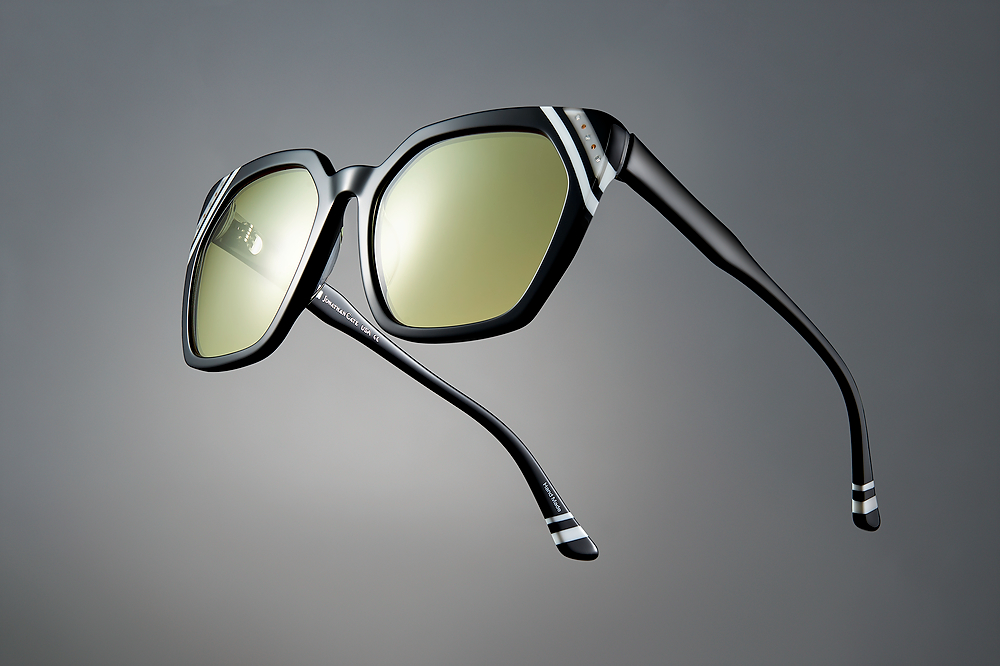
Some shots are more complex than they look and a shot list helps your photographer determine the shoot time required to complete your list. Do you recall the the above behind-the-scenes photo for the “simple” shot of sunglasses below? If you need an additional angle, it won’t be a simple matter of just moving the camera. For the loaf of bread, it probably will be, but for reflective objects, adding a few more angles can significantly extend a shoot day.
Efficiency on Set
For a moment let’s go back to:
Following along? I post the behind‑the‑scenes from shoots like this on Instagram → @shogunmasterphoto
Shot #1: Horizontal (landscape) shot, waist up, of female model holding green smoothie product with beach/coastal element in background.
Of course we’re going to take loads of photos of this scenario to create options for a client, but the ultimate goal is to walk away with one “winner” which we can retouch and finalize. Once the photographer and client look at a laptop or back of a camera and agree that the shot has been achieved, we can comfortably and confidently move on to the next shot, making the most of our shoot day.
“But I Don’t Want to Ruin Your Creativity”
Don’t worry, you wont. Having a clear goal makes a photographer MORE creative. There are so many elements besides just the overall concept and we creative types are always overwhelmed mentally with ideas. Our brain is pulling us in a thousand photographic directions.
You might think more freedom=more creative freedom, but In the absence of a shot list, we can shoot “models with product” on the beach all day and not really have much sense of when we’ve “got it.” This can waste enormous amounts of time and effort on the wrong things and limit creativity rather than encouraging it.
How to Create a Shot List
Honestly, I’ve received all type of lists from Excel sheets to Word documents, to PDF’s to everything crammed into an email. All work just fine but here’s some tips that in my opinion really help out the photographer and crew. Now that you know the types of shops that could be included in your shot list, it’s time to break down the process of creating a shot list.
- List the types of shots you need
- List individual shots you want for each type
- Add details for clarity and precision
- Provide lighting, background, prop, location, and other important information
Put it all in one document. If you have a creative brief or general guidelines as well as layout request from potential vendors and your own shot list, it best to consolidate everything into one document so it can all be quickly and easily accessed on shoot day. This is especially true if your layout requests are general IE: “horizontal shot” but your potential retailer’s requests are highly specific IE: Target requires square cropped images of exactly 2000 by 2000 pixels.
In the sections below, I’ll go step-by-step – taking you from a blank piece of paper to a complete, detailed shot list.
1. List The Types Of Shots You Need
As you get into the nitty-gritty, you should group your needs by the image categories we discussed above. If you prefer, you can separate individual shots by whatever category you choose. Maybe you want to separate by use case – think general imagery, specific product launch, marketing campaign, etc.
Whatever you land on, you must create a hierarchical organization to build a robust, detailed shot list.
2. List Individual Shots You Want For Each Type
Once you’ve determined your organizational categories, start listing the specific shots that you want the photographer to capture. While you’ve likely had the shots in your mind, it’s extremely helpful to lay them out on paper – specifically separating each individual shot by the category it lies in.
If you list out every shot that you think you need but don’t put in the work to organize them into structured categories, you risk missing important images.
3. Add Details For Clarity And Precision
Aside from expressing the technical components of the shot, you can leave notes that help the photographer understand what you’re trying to get out of a shot or what you’re looking for.
If you want an emotional advertising scene, you should detail what type of emotion the viewer should feel, how each individual in the scene should be staged, or how you plan to crop or edit the image for its intended use.
4. Provide Lighting, Background, Prop, Location, And Other Important Information
Primarily for the photographer, the shot list should include information about lighting, background setting, props, location, and any other important information. As you work with your photographer, make sure every detail is vocalized so you don’t miss anything.
For example, if you have a product launch that you want accompanied by a purple hue it’s important to access lighting and assign a wardrobe that matches the desired vision.
Business Photography Shot List Example
If you’re still not 100% certain what a shot list should look like, I’ll drop an example below. This is an example shot list for a local law firm with a relatively tight budget. It’s also extremely brief – most shot lists will be much more robust to capture every image desired.
Category: Portraits and Headshots
- Shot type: Individual headshots of each staff member
- Details: Set outside of the office with a natural background, semi-formal attire
- Shot type: Portrait of managing partner 1
- Details: Try to capture a friendly, welcoming vibe
- Shot type: Portrait of managing partner 2
- Details: Capture professionalism and attention to detail with them sitting at their desk, diligently focused on a task at hand
- Shot type: Team portrait
- Details: All of the staff in one modern, professional shot to showcase the team in one image.
Category: Commercial Lifestyle
- Shot type: Wide shot of employees interacting within the office
- Details: The image should look natural and promote collaboration within the office, highlighting how the team works together to make the best case for any client.
- Shot type: Managing partner meeting with client
- Details: Portray a personable, caring experience that leaves potential clients confident that they’ll have a meaningful experience.
Category: Corporate
- Shot type: Landscape shot of the firm’s main lobby
- Details: Capture the welcoming yet organized, professional environment with modern design
- Shot type: Empty conference room
Make sure your spreadsheet is printable
I like to carry old fashioned paper on shoot day in case my phone goes out of service or low on battery. I usually like to hand a copy to an assistant or tech if I have one too so they can help track what we’ve completed. For the final shot list, its nice to convert to PDF or at least make sure your spreadsheet will print on a page without getting wonky.
Include printable Reference Images
If you’ve done a photo shoot in the past, and can provide reference images or links to reference images this is extremely helpful!

This is a super simple shot list for product shots on white, but not much info is needed because the client provided reference images. Part numbers and SKU’s are helpful for tracking product shoots. Please include the name/description of the item though, as we may not really know what a MNG-47-47B is.
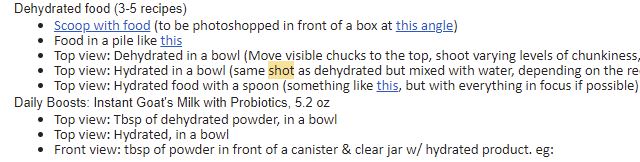
This is a more specific list, dropped right into an email and easy to print! I like these.
Shot List And Beyond: Other Important Information For A Successful Photoshoot
While I tried to get all of my thoughts into the sections above, I have a few more nuggets of information and thoughts to share with you. These are important bits of information that you may overlook as a client of a photographer.
- Location scouting and timeline prep. You don’t want to go into a photoshoot blind. Make sure that you’ve visited any additional locations that you plan to shoot at. For your employees’ and your best interest, create a timeline of how you envision the day going. By establishing an agenda, you hold your team accountable to a specific chunk of time and avoid interrupting day-to-day operations.
- Licensing and photo usage agreementsMake sure that you discuss with your photographer who owns the usage rights to the photos. Typically, you, as the client, will own the rights; however, you don’t want to risk a miscommunication.
- Image and file types. If you’re unsure, ask your photographer what file types are best for your specific use of the images. If you’re simply looking for photos for social media, there’s no need to ask for a TIFF file.
- Creating and managing an asset libraryOrganizing and storing all of your images and visual assets is vital to your success. You don’t want to just throw all of the images onto a hard drive with no folders. Consider using a digital asset management (DAM) system. It helps clearly organize all of your assets so that anyone who needs to can access them with ease.
Schedule An Efficient Commercial Photoshoot With Shogunmaster Photography
Now you should have a better understanding of what a shot list is and how important it is to plan out your photo shoot to get the most out of your investment. Collaborating with your photographer and strategically planning your shot list helps to highlight your needs and goals.
Shogunmaster Photography offers professional corporate photography, working in various industries and with businesses of all sizes. Jeffrey has years of technical training and experience in the field, along with a robust understanding of the relationship between photography and corporate branding. If you’re new to photo shoots and need any help developing your shot list, I am here to help! In Many cases, we can collaborate on a quick call or sit down at your office to get something planned out. To learn more about photography shot lists or to get the ball rolling on a project, fill out a contact form.